
Your schedule is important
Sticking to your injection schedule is key for the medication to keep working.


Talk to your healthcare provider to learn more about YEZTUGO.

YEZTUGO is a prescription medicine used as HIV-1 PrEP to reduce the risk of getting HIV-1 in adults and adolescents who weigh at least 77 pounds. You must be HIV negative before and while receiving YEZTUGO.
PrEP stands for pre-exposure prophylaxis. It's a prescription medicine you take before you come in contact with HIV. Routinely taking PrEP helps protect against HIV through sex.


Your schedule is important
Sticking to your injection schedule is key for the medication to keep working.

YEZTUGO is given every 6 months
YEZTUGO is given by your healthcare provider every 6 months (2 injections per visit, after starter dosing). When you first start YEZTUGO, starter dosing includes 2 pills and 2 injections at your provider's office and 2 more pills the next day at home. (No pills after initial 2-day dosing).

Support is available
The Ready to Go™ program is available to help you stay informed and ready throughout your YEZTUGO experience.
Get ready with this pre-appointment checklist
Whether you're just starting YEZTUGO or returning for ongoing injections, make sure you are prepared with the following information:
if your medical and prescription benefits are separate, especially if your coverage has changed since your last appointment.
Before each injection visit, talk to your healthcare provider about HIV testing. You must be HIV-1 negative to receive YEZTUGO.
and supplements you are currently taking. Some medicines may interact with YEZTUGO. Also be prepared to share your sexual health history and overall health with your provider.
for your next injection appointment in 6 months. Your next appointment can be scheduled up to 2 weeks before—or 2 weeks after—your 6-month mark.



If you think you may miss your next scheduled appointment,
contact your healthcare provider right away to discuss your options.
After that, you’ll receive injections every 6 months
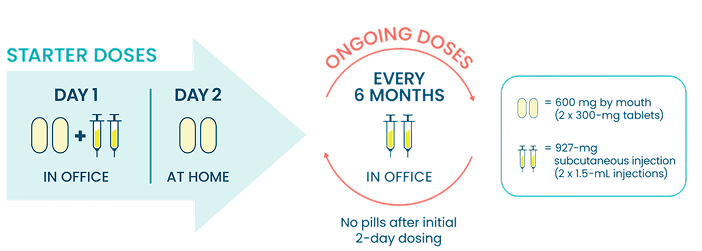
Starter doses are required when you begin YEZTUGO and pills should be taken as your healthcare provider tells you. If you miss taking your pills on Day 2, take them as soon as possible. Your Day 1 and Day 2 pills should not be taken on the same day. Talk to your healthcare provider if you have any questions or concerns.
It is important to continue receiving YEZTUGO as scheduled. Missing YEZTUGO injections or pills may increase your chance of getting HIV-1.

Your healthcare provider will make sure you’re ready, confirm your HIV-negative status, and answer any questions you may have.
Your care team gets everything prepared for you to receive YEZTUGO.
If this is your starter appointment (first YEZTUGO visit), you will take 2 pills and receive 2 injections. Your healthcare provider will give you 2 more pills to be taken at home the next day.
If this is an ongoing appointment and you already had your starter dosing, you will only get 2 injections given by your healthcare provider.
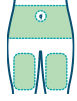
You and your healthcare provider will choose the injection site together. The injections reach a short distance under your skin (subcutaneous injection) and are given in your abdomen or thigh.

Your healthcare provider will give you 2 injections. You may experience some discomfort where the injection is given. You should talk to your healthcare provider about ways to help address this before and after your injections, which could include the use of ice packs and/or pain relief medications.
Please note, these considerations are not specific to YEZTUGO.
You are encouraged to report negative side effects of prescription drugs to the FDA. Visit www.fda.gov/medwatch, or call 1-800-FDA-1088.
Be sure to schedule your next appointment
Before you leave the office, it’s a great idea to schedule your next 6-month appointment, including HIV testing.
After each appointment
The most common side effects* among people taking YEZTUGO in clinical trials
PURPOSE 1 and PURPOSE 2 were two randomized, double-blinded studies where more than 6400 people were given either YEZTUGO or a daily PrEP pill (FTC/TDF). The most common side effects in ≥2% of people taking YEZTUGO through one year include†:
Side Effect
Injection site reactions in ≥2% of people taking YEZTUGO included a bump, pain, skin hardening, swelling, itching, redness, bruising, or warmth.
There were no serious injection site reactions.
In each of the 2 studies:
About 1 out of 3 people who received YEZTUGO did not feel or see a bump
These bumps (and other injection site reactions) became less common with later shots of YEZTUGO.


*These are not the only possible side effects.
†Researchers looked at how well YEZTUGO worked in a planned early analysis once 50% of the people had been in the study for a year.
‡FTC/TDF=emtricitabine/tenofovir disoproxil fumarate. People taking FTC/TDF also received placebo injections.
§<1% of people in each study stopped FTC/TDF due to side effects.


your scheduled YEZTUGO appointment by more than 2 weeks, call your healthcare provider right away to discuss your options

IMPORTANT SAFETY INFORMATION
YEZTUGO (lenacapavir) injection, 463.5 mg/1.5 mL, is a prescription medicine that is used as HIV-1 PrEP (pre-exposure prophylaxis) to reduce the risk of getting HIV-1 in adults and adolescents who weigh at least 77 pounds (at least 35 kg). You must be HIV negative before and while receiving YEZTUGO.
What is the most important information I should know about YEZTUGO?
Before and while receiving YEZTUGO:
Who should not receive or take YEZTUGO?
What are the possible side effects of YEZTUGO?
What should I tell my healthcare provider before receiving YEZTUGO?
You are encouraged to report negative side effects of prescription drugs to the FDA. Visit www.fda.gov/medwatch, or call 1-800-FDA-1088.
Please see Important Facts about YEZTUGO, including important warnings.
YEZTUGO (lenacapavir) injection, 463.5 mg/1.5 mL, is a prescription medicine that is used as HIV-1 PrEP (pre-exposure prophylaxis) to reduce the risk of getting HIV-1 in adults and adolescents who weigh at least 77 pounds (at least 35 kg). You must be HIV negative before and while receiving YEZTUGO.

